· AR · 7 min read
How to make augmented reality reduce product returns for furniture and decor
AR can head off some furniture, decor, and rug returns before shoppers order, but not all of them. See which ones, and what your 3D models need so returns don’t go up.
Is it going to fit? Shoppers ask themselves that before ordering a sofa, an armchair, a refrigerator, a backyard pool, or any other bulky item, and it isn’t always easy to tell from a screen. If they guess wrong, the item has to be hauled back, and that’s rarely cheap, for you or for the shopper.
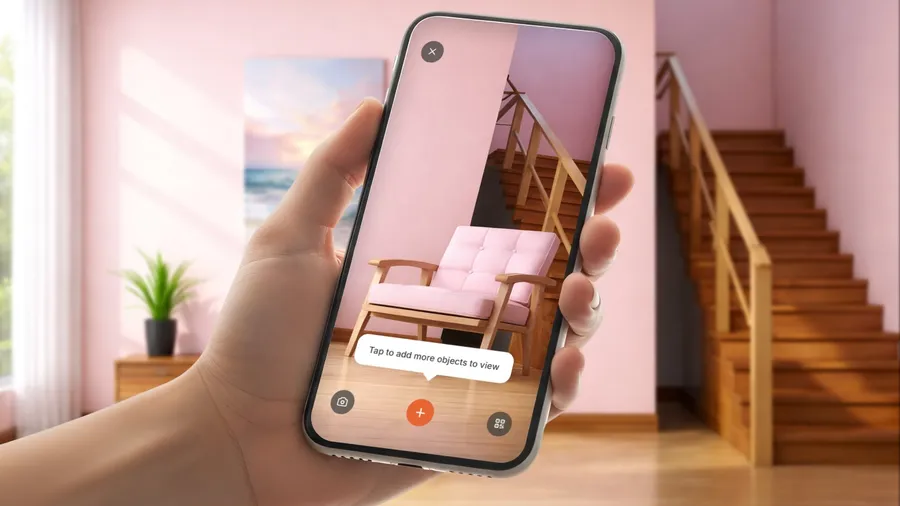
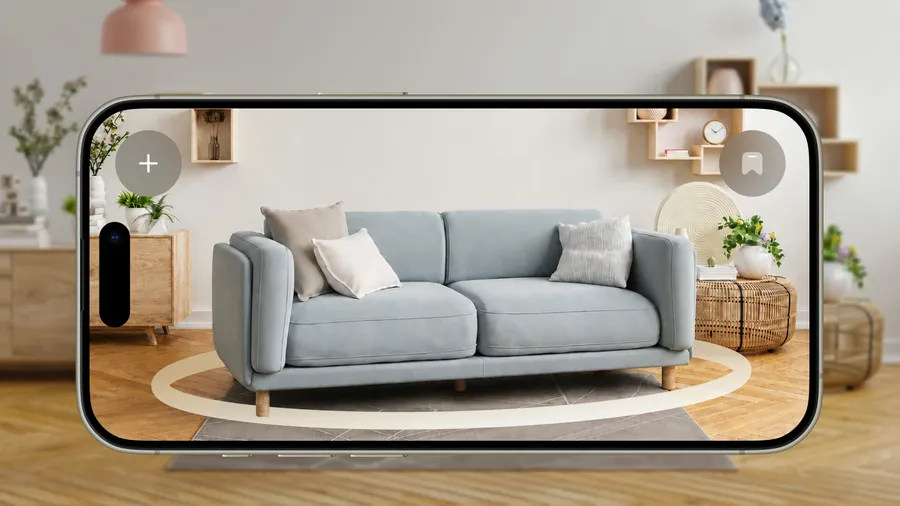
Augmented reality (AR) can reduce product returns like these. Shoppers point their phone at the spot they have in mind, and a 3D model of your product appears right there on the screen.
Here’s when AR can actually cut returns, and how to set it up so it helps you sell instead of putting shoppers off.
Which product returns you can prevent before checkout
In the fall of 2025, US retailers expected shoppers to send back an average of 19.3% of their online purchases that year, according to the National Retail Federation. Shopper surveys show why. YouGov found in September 2025 that 44% of Americans who’d returned something said the item didn’t meet their expectations for quality, color, or size, and 34% said it arrived damaged or defective. In a February 2024 survey by the International Council of Shopping Centers, shoppers said they’d returned online orders because the item arrived damaged (52%), didn’t fit (50%), wasn’t as expected (42%), or wasn’t what they’d ordered (37%).
With furniture and other bulky items, some of these problems can be caught before checkout, and some can’t. Shoppers can check in advance whether a piece is too big and how it will look in their room. That’s where AR helps. Defects, shipping damage, and packing mistakes only show up after delivery, and neither AR nor the usual photos and videos on the product page will catch them.
| Return reason | What AR can do | What else helps |
|---|---|---|
| Didn’t fit, or was bigger or smaller than expected | Shows the product in the room at full size, as long as the model’s dimensions are accurate. | Dimensions listed next to the AR button |
| Clashed with the room, or wasn’t the right style | Shows how the product looks in the shopper’s own room. | — |
| Color or finish looked different in person | Shows the color next to the shopper’s floor and furniture, if the model’s color matches the product. If the product arrives in a different shade, AR can add to returns. | Daylight photos, fabric swatches |
| Wasn’t comfortable or well made enough, or the material didn’t feel right | Nothing | Fabric content, materials, and reviews next to the AR button |
| Arrived damaged or defective | Nothing | Packaging and delivery |
| Wrong item or missing parts | Nothing | Picking and packing |
To see how big retailers use AR on their product pages, browse our roundup of augmented reality website examples.
What the research says: AR can cut returns, but there’s a catch
Amazon, which has offered AR previews for furniture and other categories since 2017, says the previews have cut style-related returns by more than 40% on products shoppers viewed in AR before buying. That’s more than 660,000 products, furniture included, according to the company’s 2024 sustainability report.
In a 2024 study, researchers at Arizona State University and City University of Hong Kong analyzed data from online stores and found that AR lowered returns on products shoppers wanted to see in their own space before buying, and raised them on products where that didn’t matter much. They chalk the increase up to a misleading wow factor: shoppers like how the item looks in AR, overlook everything else about it, and may end up sending it back.
Furniture, large appliances, gazebos, and backyard pools are exactly the kind of products shoppers need to see at home before they buy.
Researchers at Erasmus University Rotterdam focused on size. In a paper for the European Marketing Academy’s 2025 conference, they write that AR can reduce returns when it shows a product’s size accurately. When it gets the size wrong, it inflates shoppers’ expectations.
And when the product falls short of what shoppers saw in AR, returns can go up. A 2026 article in the International Journal of Research in Marketing describes an experiment with two groups of shoppers. One picked out shoes using only regular photos and text descriptions; the other used AR as well. Then the researchers deliberately sent out pairs with defects and color mismatches. In the end, 65% of the AR group returned their shoes, compared with 37% of the photos-and-text group. Still, as the authors put it, “These findings do not refute prior research indicating that AR may reduce returns under normal conditions.”
Research on how AR affects returns in specific categories is still thin, but what there is suggests that augmented reality can reduce product returns when shoppers aren’t sure whether something will fit or how it will look in their home. The catch is that the 3D model on your product page has to show exactly what shoppers will get. Otherwise, returns may even go up.
Reduce returns on large furniture first, then on rugs and wall art
Start with anything that arrives with a delivery crew: sofas, beds, wardrobes, dining tables. Shoppers can study the photos and the dimensions and still not know whether the piece will fit or block a walkway. A wrong guess is slow and expensive to undo. With AR, shoppers place the piece in their room and can spot the mistake before they order, as long as the model is built to the real dimensions on your product page.
Rugs, paintings, and posters come next. AR can be useful here too, since style plays into the choice: shoppers want to know whether the rug really ties the room together and how a painting will look on the wall next to their furniture.
You’re better off skipping AR on products shoppers choose by feel, like mattresses, pillows, and comforters. On those, it can backfire and add to your returns.
How to keep AR from adding to your returns
Above all, the model has to match what actually shows up at the shopper’s door. If what arrives looks different, the model has set expectations the product can’t meet, and a return becomes more likely. Get the dimensions exact, too. A model that shoppers can resize freely in AR may look bigger or smaller than the product really is.
Shoppers may also put off buying if the 3D model is low quality or the AR interface is clumsy. Both came up when participants in a Baymard Institute UX study explained why they held off after trying AR.
Don’t forget the rest of the product page, either. AR can answer only one question: how will this look in my home? To get shoppers interested in the first place, you still need good photos, video, and a product description.
How to design your AR button →
How to add AR to your product pages with VIZBL
Core AR hosts your 3D models and gives you ready-made code (a button and a script) to paste into your product pages. Shoppers tap the button and see the product in their room. Our AR doesn’t let them resize the model freely, so an accurate model stays accurate. On a recent phone, shoppers can also switch the upholstery color or finish right in AR.
The quickest way to get a model for AR is to generate it from your product photos. That works for a test run, but check the size and color before it goes live. For a better model, have a 3D artist build it, the way our artists did for Sean Woolsey Studio and Estudio pm. It costs more, but it’s the way to go for large, expensive items, where a wrong size or color can turn into a return.
Photo to 3D → · 3D furniture modeling →
For rugs and wall art, you don’t need a 3D model at all. Set up a VIZBL account and upload the images you probably already use on your product pages. VIZBL builds the in-room previews automatically, so all that’s left is to add the widget code to your site.
Let shoppers see a product in their own room before they order, and you can head off “didn’t fit” returns. Try Core AR, Rugs, or Wall Art yourself for free, or get in touch and we’ll put together a demo with your products.